![[Translate to English:] Petra Keller](/fileadmin/_processed_/a/1/csm_petra_keller_e44ef7ef02.png)
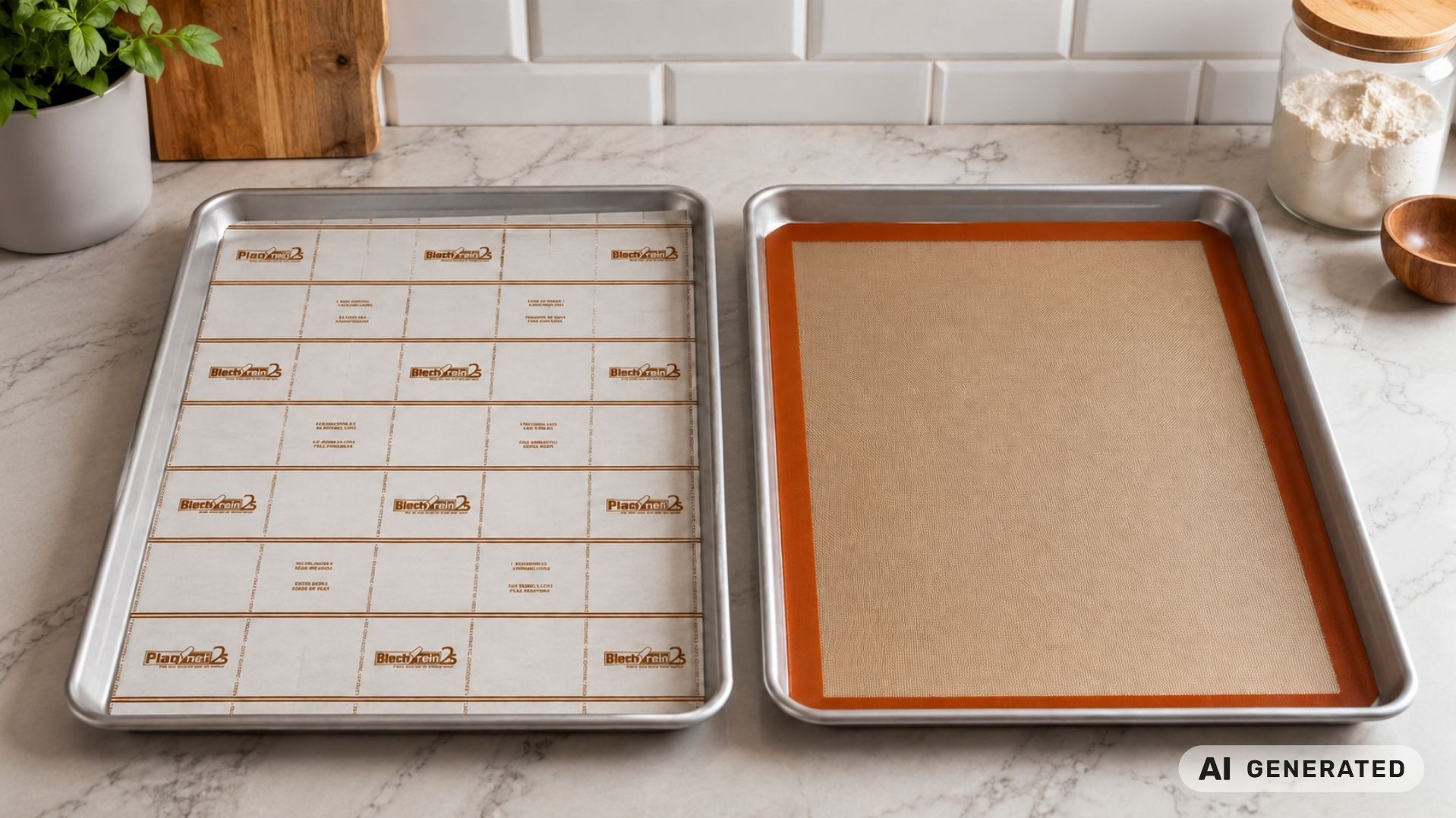
Baking paper has been a standard feature of baking processes for decades – both in the home and in professional food production. It has established itself as a reliable solution for preventing food from sticking, keeping processes clean and achieving consistent results. However, with increasing demands for sustainability and resource efficiency, alternatives such as baking mats are coming increasingly into focus. They are considered a durable option and are frequently discussed as a replacement. But how do the two solutions differ in practical use? It is not only the material and lifespan that are decisive, but also factors such as handling, cleaning effort and process efficiency.
Key points on baking paper vs. baking mats
- Baking paper is the established standard, while baking mats are used as an alternative for specific applications
- Baking paper offers high flexibility, as it can be replaced quickly and used without cleaning
- Baking mats stand out due to their durability, but require regular cleaning processes
- The optimal solution depends on the application, particularly in terms of process requirements, efficiency and handling
What is baking paper and how is it used?
Baking paper is a proven solution for non-stick applications in baking and food processing. Thanks to its special coating, it prevents doughs, mixtures or delicate products from sticking to trays, moulds or equipment surfaces.
Such papers are used wherever clean working conditions, consistent results and efficient material changes are required. They can be cut to size flexibly, replaced quickly and integrated easily into different processes.
What is a baking mat and how does it work?
Baking mats were developed as an alternative and are usually made of silicone or silicone-coated fabrics. They are designed for repeated use and remain on the tray or in the system for several baking cycles.
Their strength lies in their dimensional stability and long-term use. They are often used especially in consistent processes with standardized workflows.
At the same time, they are less flexible, require regular cleaning and can only be adapted to different formats or changing requirements to a limited extent.
Baking paper vs. baking mat: Differences and sustainability compared
The two solutions differ above all in handling and the process environment. Paper-based release liners allow for quick replacement and a high degree of flexibility, while mats are designed for long-term use in stable workflows.
When it comes to sustainability, two different approaches become clear: reusable mats are designed for a high number of use cycles, but they involve continuous cleaning effort – including the consumption of water, energy and cleaning agents.
High-quality baking papers can be used multiple times and do not require cleaning between uses. This eliminates additional process steps and reduces the overall effort. At the same time, material consumption remains a factor that must be taken into account.
The ecological assessment results from the interplay of frequency of use, cleaning intensity and process requirements.
Cost-effectiveness and efficiency in application
From an economic point of view, the two solutions also show different strengths. Paper-based solutions enable quick changes and significantly reduce the effort required for cleaning and handling.
Baking mats spread their acquisition costs over a longer service life, but they create ongoing effort for cleaning, storage and replacement due to wear.
In practice, there are clear differences: in cases of frequent product changes and dynamic workflows, flexible release papers stand out for their efficiency and time savings. In stable processes with consistent requirements, baking mats can be economically viable.
Areas of use in households and the food industry
Both solutions are used in households. Paper-based variants offer easy handling and flexibility, while mats are mainly used for recurring applications.
In the food industry, additional requirements come into focus, including hygiene, process reliability and efficiency. Specialized baking papers – such as Blechrein baking paper, for example – are particularly suitable for applications with frequent changes or sensitive products. Baking mats are mainly used where processes are constant and clearly defined.
Conclusion: When is baking paper or a baking mat the better choice?
Both solutions fulfill important functions and have clear areas of application. Baking mats show their strengths in long-term, stable applications.
Paper-based solutions offer advantages in flexible processes, in cases of frequent changes and wherever easy handling and fast workflows are required.
The best choice depends on the specific requirements of the process – particularly with regard to flexibility, cleaning effort and efficiency.

Optimize your baking processes with the right paper solution: High-quality baking papers enable efficient workflows, reduce cleaning effort and ensure consistent results. Get individual advice and find the right solution for your application.
Contact us nowBaking paper is a flexible release liner that can be cut easily and replaced quickly. Baking mats are reusable liners designed for long-term use, but they must be cleaned after each use.
Yes, high-quality papers – such as Blechrein baking papers, for example – can be used multiple times as long as they remain undamaged and retain their non-stick properties. This helps reduce material consumption significantly.
That depends on the application. Baking mats avoid waste, but they require cleaning with water and energy. Reusable baking paper reduces material consumption and does not require cleaning. The overall assessment depends on the specific use case.
Baking paper is particularly suitable for flexible processes with frequent changes. Baking mats are advantageous for consistent applications in which they can be used over a longer period of time.
No, not in every application. Baking mats are less flexible and require cleaning, which means they are not suitable for all processes. In many cases, baking paper is used, especially in applications with high requirements for flexibility and efficiency.