![[Translate to English:] Petra Keller](/fileadmin/_processed_/a/1/csm_petra_keller_e44ef7ef02.png "[Translate to English:] Petra Keller")
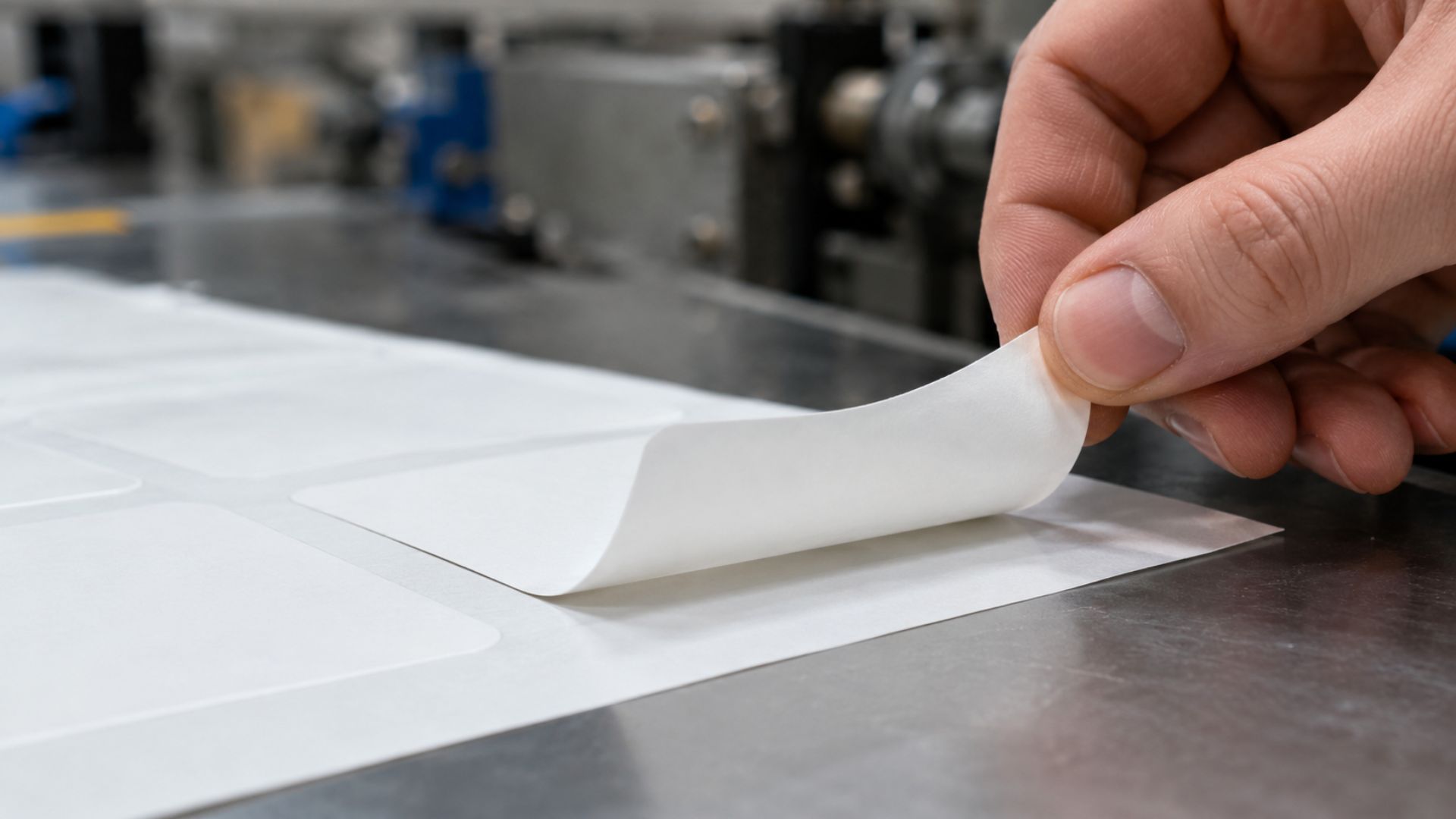
Siliconised paper is a versatile specialty paper that is indispensable in numerous industries – wherever materials need to be reliably separated from one another, adhesive surfaces protected, or surfaces secured during production. A thin silicone coating gives the paper pronounced non-stick properties, making it the ideal release material for labels, adhesive tapes, composites and many other applications. In this article, you will learn how siliconised paper is manufactured, which types are available, where it is used – and what sets BRANOperl release paper from BRANOpac apart.
The most important facts about siliconised paper at a glance
- Siliconised paper acquires its non-stick property through a thin silicone coating – adhesives and resins can be removed cleanly and without residue.
- It is available with a single-sided or double-sided coating and is applied to base materials such as glassine, kraft paper or CCK.
- Typical areas of application include the composites industry, label and adhesive tape production, as well as textile printing and technical applications.
- BRANOperl from BRANOpac is available in grammages from 41–176 g/m², bleached or unbleached, and with custom printing.
What is siliconised paper? Definition and manufacturing process
Siliconised paper – also referred to as silicone paper, release paper or release liner – is a specialty paper whose surface has been coated with a thin layer of silicone. This coating gives the paper its characteristic non-stick property: adhesives, resins and other tacky materials can be removed cleanly and in a controlled manner without leaving any residue.
Manufacturing process
In the manufacturing process, a suitable base paper – such as glassine, kraft paper or CCK paper – is coated with a silicone formulation. The silicone is applied in liquid form and then cured thermally or by UV radiation. Depending on the desired release value and application, the quantity and composition of the silicone can be specifically varied. The result is a paper that repels most adhesives and resins without losing its mechanical stability.
Key properties
The most important properties of siliconised paper are its non-stick effect, good heat resistance and high processing reliability in industrial processes. It is also available in a range of grammages – typically between 35 g/m² and over 150 g/m², depending on the manufacturer and application – and can be supplied as roll goods as well as cut sheets or custom-cut formats.
Types at a glance: Single-sided, double-sided and various base materials
Siliconised paper is not a one-size-fits-all product. Different variants are used depending on the application, differing both in the type of coating and the base material used.
Single-sided siliconised paper
With single-sided siliconised paper, only one side of the base paper is coated with silicone. This variant is used wherever one side of the paper needs to perform a release function – for example as a protective liner for self-adhesive labels or as an interlayer in production processes.
Double-sided siliconised paper
Double-sided siliconised paper is coated on both sides and is primarily used when a non-stick function is required on both sides – for example in the production of double-sided adhesive tapes or as a separator between multiple layers of tacky materials.
Base materials: Glassine, kraft paper and CCK
The base material has a significant influence on the properties of the finished release paper. Glassine is a supercalendered, dense paper with a very smooth surface, particularly suited to fine applications in the label and graphic arts industries. Kraft paper (e.g. SCK) offers greater mechanical strength and is preferred in industrial applications where robustness is required. CCK paper (Clay Coated Kraft) combines the stability of kraft paper with a coated, smooth surface and is well suited to precision printing processes on the liner.
Applications: Where is siliconised release paper used?
Thanks to its versatile properties, siliconised paper is used in a wide range of industries and production processes. Its non-stick effect makes it a reliable aid wherever materials need to be temporarily separated, protected or guided.
Composites industry
In the manufacture of laminates and composite materials, siliconised release paper is used as an interlayer during thermal pressing. It prevents the individual material layers from bonding together and facilitates the removal of finished panels from the press. After pressing, it can be peeled off cleanly and without residue.
Labels, self-adhesive tapes and adhesive tapes
In the self-adhesive industry, release paper is indispensable as a carrier and protective material for labels, stickers and adhesive tapes. The liner protects the adhesive surface from contamination and enables controlled release of the adhesive at the point of application.
Textile printing and transfer paper
In textile printing, siliconised paper is used as transfer paper and release paper for the thermal fixing of print motifs. It absorbs the applied ink or film and releases it in a controlled manner onto the textile during the pressing process. In sublimation printing, it is recommended to replace the paper after each print run.
Technical applications
In technical sectors, siliconised release paper is used as an interlayer for liquid bitumen, as a lining for casting moulds and as a release layer in rubber and raw rubber production. It is also widely used in office applications – for example as release paper for household films, labels and self-adhesive stickers.

Are you looking for a reliable siliconised release paper for your industrial application? BRANOperl from BRANOpac is available in numerous grammages and formats – including custom printing. Get in touch with us and we will find the right solution for your process together.
Contact us nowBRANOperl – the siliconised release paper from BRANOpac
BRANOperl is the single- or double-sided siliconised release paper from BRANOpac GmbH. It has been developed specifically for demanding industrial applications and is characterised by its reliable release properties and good heat resistance.
Product properties and variants
BRANOperl is available both single- and double-sided siliconised and can be supplied in bleached or unbleached versions depending on application requirements. Its release property reliably prevents strip- or sheet-form materials from bonding together or adhering to other surfaces – even under thermal stress. BRANOperl is available in grammages from 41 g/m² to 176 g/m² and can be supplied as roll goods, sheets or custom-cut formats.
Typical applications of BRANOperl
BRANOperl is used across a wide range of industries: as an interlayer during the thermal pressing of laminates in the composites industry, as release paper for labels and stickers in office supply applications, and as a separator for liquid bitumen and in rubber production. BRANOperl is also used as transfer paper in textile and film printing.
Sustainability
BRANOperl can be used for energy recovery. Uncontaminated BRANOperl can additionally be materially recycled, supporting a resource-efficient approach to end-of-life material management.
Custom printing
All BRANOperl products are available with custom printing on request – for example with company names, product designations or application instructions. This makes BRANOperl a usable advertising surface within the production process.
What should be considered when selecting a release paper?
Choosing the right siliconised paper depends on a number of technical and process-related factors. Understanding the following criteria will help you make the right decision for your application.
Grammage and release value
The grammage – i.e. the basis weight in g/m² – largely determines the stiffness and stability of the release paper. Lighter papers are suitable for fine applications and automated processing machinery, while heavier grammages are preferred in mechanically demanding processes. The release value indicates how easily the paper can be peeled from the adhesive surface and should be matched to the type of adhesive used.
Temperature resistance
In processes involving thermal stress – such as laminating, pressing or textile printing – the heat resistance of the release paper is a critical selection criterion. It is advisable to compare the maximum temperature range of the paper with the process requirements.
Sustainability and certifications
Certifications play an important role for sustainability-oriented purchasing decisions as well as in regulated industries. Key considerations include FSC or PEFC certification for sustainably managed raw materials, as well as the recyclability of the paper at the end of its useful life.
Siliconised paper is a specialty paper whose surface has been coated with a thin layer of silicone. This coating gives the paper a non-stick property: adhesives, resins and other tacky materials can be removed cleanly and in a controlled manner without leaving any residue. It is also referred to as silicone paper, release paper or release liner.
With single-sided siliconised paper, only one side is coated with silicone – it is suitable as a protective liner for labels or as an interlayer in production processes. Double-sided siliconised paper is coated on both sides and is used when a non-stick function is required on both sides, for example with double-sided adhesive tapes.
Siliconised release paper is used in the composites and composite materials industry, in label and adhesive tape production, in textile and film printing, and in technical sectors such as rubber production and bitumen applications. It is also widely used in office applications – for example as release paper for labels and self-adhesive stickers.
BRANOperl is the single- or double-sided siliconised release paper from BRANOpac. It is available in grammages from 41–176 g/m², bleached or unbleached, and is characterised by reliable release properties and good heat resistance. Uncontaminated BRANOperl can also be materially recycled. Custom printing is available on request.
Key selection criteria are the grammage (basis weight in g/m²), the release value matched to the adhesive type, and the heat resistance for thermal processes. For sustainability-oriented requirements, certifications such as FSC or PEFC are also relevant.