
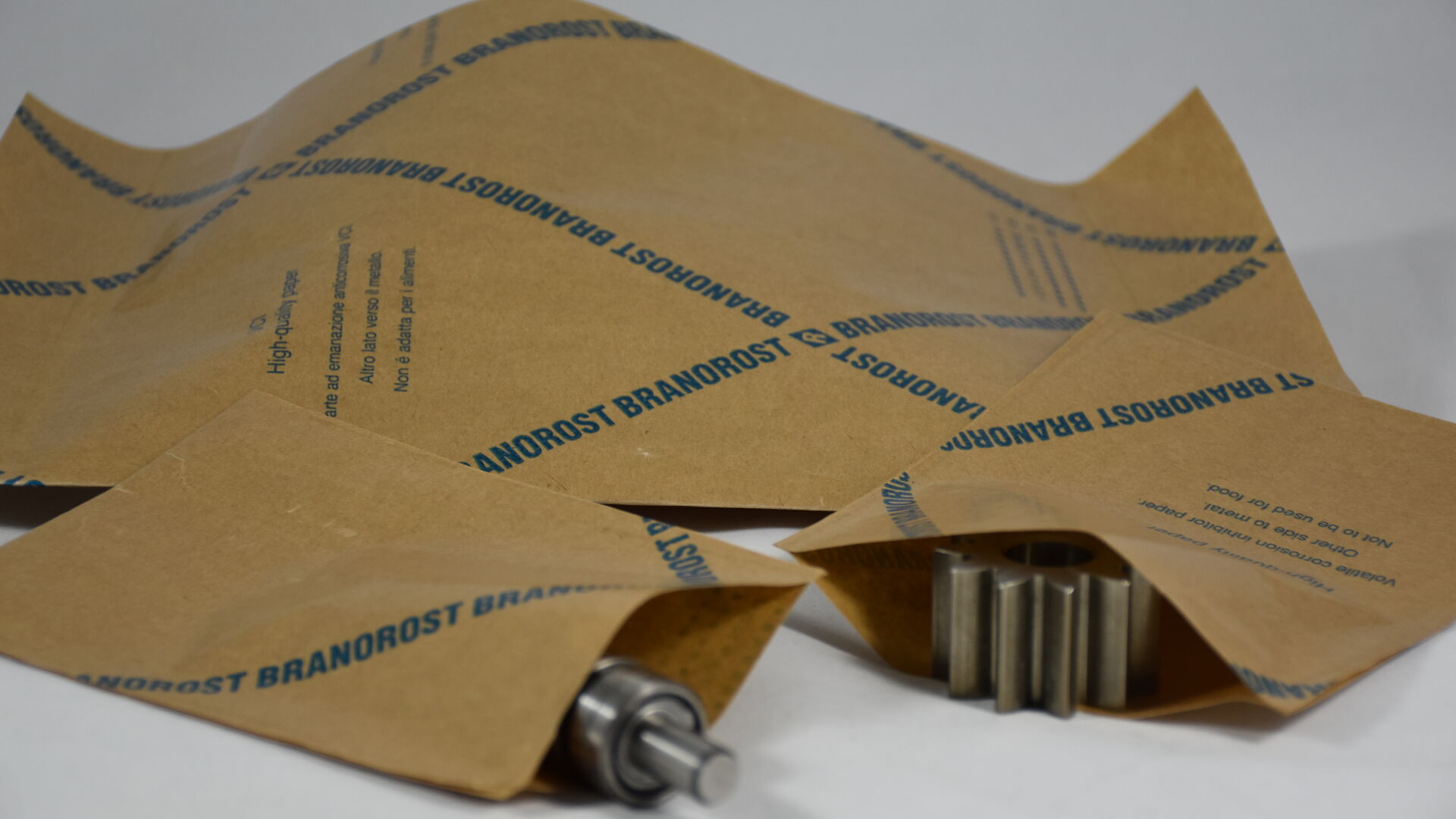
Metal parts arriving covered in oil and requiring time-consuming cleaning before further processing – that was long considered standard practice. Temporary VCI corrosion protection eliminates this step entirely. Parts arrive at their destination clean, dry and ready for immediate use. This article explains the technology behind it, the concrete advantages it offers and where it performs best.
The Key Facts about Temporary VCI Corrosion Protection at a Glance
- VCI inhibitors protect metal surfaces in gaseous form – entirely without oils or greases
- Metal parts arrive clean, dry and ready for immediate use
- No solvent-based cleaning processes – no hazardous waste from cleaning agents
- Depending on material and conditions, long-term protection over several years is possible
What Is Temporary VCI Corrosion Protection – and How Does It Work?
VCI stands for Volatile Corrosion Inhibitor. These are chemical compounds that, in addition to their corrosion-inhibiting properties, also possess vapour pressure. They are incorporated into a carrier material – such as a film, paper or depot – from which they continuously volatilise.
Within a closed packaging, the VCI agents saturate the enclosed air space and deposit themselves as an ultra-thin, invisible film on metal surfaces. This film protects the passive layer of the metal and prevents sulphur-containing air constituents, moisture or other corrosion-promoting substances from reacting with the surface. A particular advantage is that VCI molecules also reach difficult-to-access areas such as bores, threads or cavities – areas that can barely be reached reliably with conventional lubricants.
Once the packaging is opened, the inhibitors volatilise without leaving any residue. The metal part is immediately ready for use – without any further treatment. Further information on the different forms of temporary corrosion protection and its variants is available elsewhere in BRANOpedia.
The Advantages of VCI Corrosion Protection over Oils and Greases
The decisive difference from classical film-forming corrosion protection lies in the handling – both when packaging and when unpacking.
With conventional methods, oils or greases are applied to the metal surface to protect it from corrosion. Before further processing, these layers must be removed – a process that requires time, chemicals and trained personnel. With temporary VCI corrosion protection, this step is eliminated entirely. The protective effect is gaseous and leaves no residue on the component.
In practice, this means:
- No degreasing prior to further processing – parts can be installed or processed directly.
- No solvent-based cleaning processes – and therefore no cleaning agents that need to be disposed of as hazardous waste.
- Simpler logistics – packaging requires no additional equipment or specialist machinery.
- Clean transport – metal parts arrive at their destination free from corrosion, dry and clean.
VCI products can also be used flexibly: as a standalone packaging solution or in combination with other protective measures – depending on requirements and desired protection duration. An overview of the available variants of temporary corrosion protection shows which product form is suitable for which application.
Long-Term Protection, Customs Security and Sustainability: Further Strengths at a Glance
Long-term protection: When used correctly and in accordance with the manufacturer's instructions, the protective effect of VCI products can be maintained over extended periods – depending on the product, storage conditions and packaging quality, potentially over several years. This makes them particularly suitable for the long-term storage of spare parts, machinery or assemblies that are not to be processed immediately.
Customs clearance without loss of protection: Where a transparent VCI film is used, customs inspections can in many cases be carried out visually, without the need to open the packaging. The contents are visible through the film, while the protective atmosphere remains intact. This is a considerable logistical advantage when exporting to countries with intensive border controls.
Sustainability and recyclability: Depending on the material used – such as paper or mono-films – VCI products are recyclable. Compared to oil- or grease-based corrosion protection, solvent-based cleaning processes and the associated disposal of cleaning agents are eliminated. This is in line with the growing demands for sustainable export packaging solutions in industry.
Where VCI Corrosion Protection Performs Best – Typical Areas of Application
Temporary VCI corrosion protection is suitable wherever metal parts are stored for extended periods or transported over long distances – and need to arrive at their destination free from corrosion, clean and ready for immediate use.
Mechanical engineering and automotive: Precision-manufactured components, engine parts, gearbox housings or brake discs are particularly susceptible to corrosion. VCI packaging can help ensure that these parts suffer no corrosion-related damage on their way from manufacturer to processor or end customer.
Export packaging and long-distance transport: On long transport routes – particularly by sea – metal parts are exposed to changing climatic conditions: temperature fluctuations, high humidity and salt-laden atmospheres. VCI products can provide effective protection even under these conditions. For overseas shipments in particular, their use as part of a well-considered export packaging solution is recommended.
Storage over longer periods: Whether spare parts, semi-finished goods or finished products – for the long-term storage of metal parts, VCI corrosion protection offers a practical, low-maintenance solution. Unlike oils or waxes, no regular inspection or retreatment of the protective layer is required.
Multi-metal protection: Depending on the product variant, VCI materials protect not only ferrous metals such as steel or cast iron, but also non-ferrous metals such as copper, brass and aluminium. This simplifies the packaging of assemblies consisting of several different metals. Details on which products are suitable for which metal type are available in the VCI corrosion protection and its application section.

Would you like to know which VCI corrosion protection solution is best suited to your metal parts, transport requirements or storage needs? Our experts are happy to advise you – from product selection through to individual packaging solutions.
Get in touch nowVCI corrosion protection shields metal surfaces without the use of oils or greases – parts arrive clean, dry and ready for immediate use. Solvent-based cleaning processes and the associated disposal of cleaning agents are eliminated. Depending on the material, the packaging is recyclable, and handling requires no specialist equipment.
The duration of protection depends on the product used, storage conditions and packaging quality. When used correctly, the protective effect can be maintained over several years. Please refer to the relevant product information for precise specifications.
No. VCI inhibitors volatilise without leaving any residue once the packaging is opened. Metal parts can be processed directly – no degreasing or further treatment is required.
Depending on the product variant, VCI materials protect ferrous metals such as steel and cast iron, as well as non-ferrous metals such as copper, brass and aluminium. Multi-metal protection variants are available for mixed assemblies. Suitability for a specific metal should be confirmed with the manufacturer in advance.
With transparent VCI films, customs inspections can in many cases be carried out visually, without opening the packaging. The protective atmosphere remains intact. This is a practical advantage for export packaging – though it depends on the requirements of the relevant customs authority.