
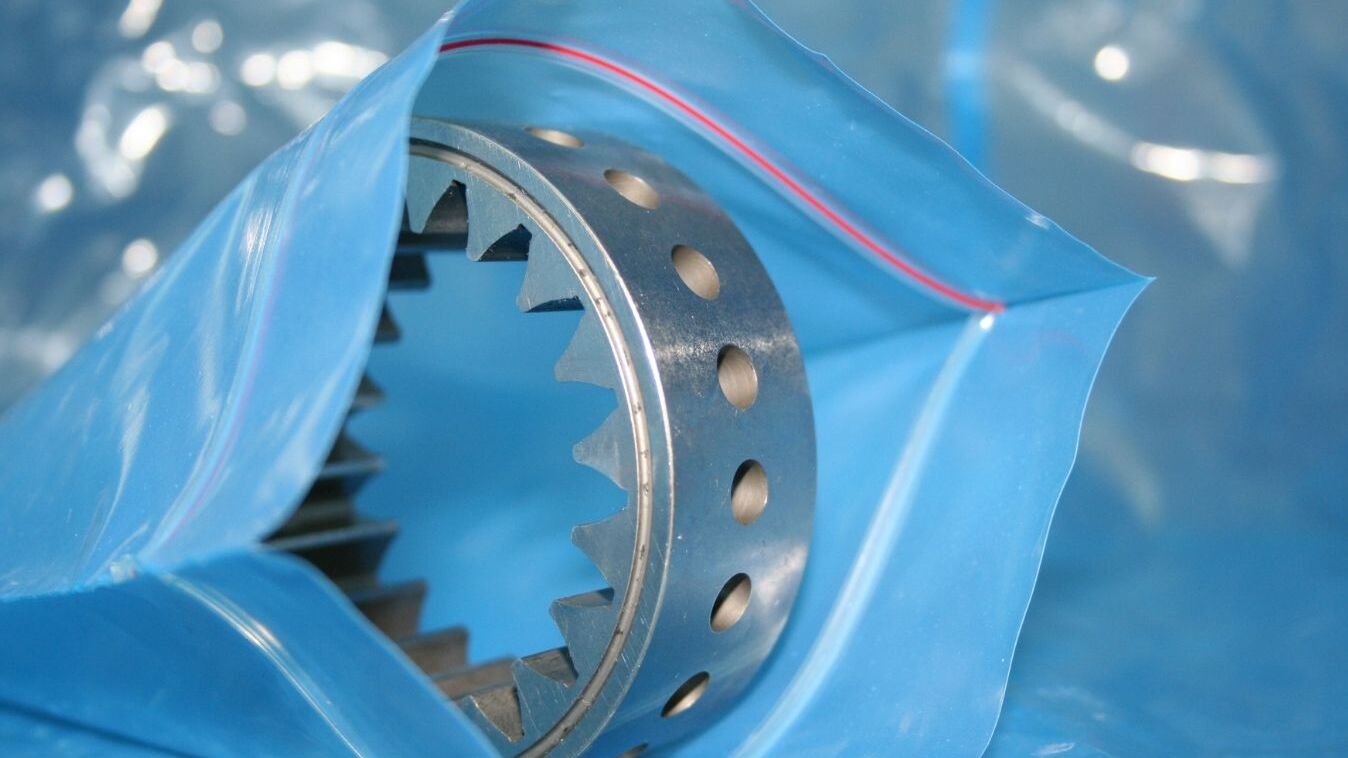
Metal parts corrode – not just in use, but often during transport and storage. Moisture, temperature fluctuations and aggressive airborne substances attack metal surfaces before a component ever goes into operation. Temporary corrosion protection addresses exactly this: it effectively protects metals throughout transport, storage and downtime – and can be removed without leaving any residue. But which method is the right choice? This article explains the three most important variants, outlines their advantages and disadvantages, and helps you select the most suitable solution.
The most important facts about temporary corrosion protection at a glance
- Temporary corrosion protection shields metal surfaces during transport, storage and downtime – and can be removed without leaving any residue
- The three main methods are the barrier coating method, the desiccant method and the VCI method – each with distinct strengths
- VCI substances sublimate into the vapour phase and actively protect even hard-to-reach areas, bores and cavities
- Depending on the metal type (ferrous or multi-metal), selecting the right VCI product is key to effective protection
What is temporary corrosion protection? Definition and distinction
According to DIN 50902, temporary corrosion protection refers to all measures that protect metal surfaces through temporarily effective, removable or reversible protective measures for the duration of transport, storage, processing or standstill periods. Depending on the method and requirements, the protection period can range from a few days to several years – for example for spare parts, discontinued series parts or tools held in long-term storage.
The key difference from permanent corrosion protection lies in reversibility: permanent methods such as galvanising, painting or coating are permanently bonded to the workpiece. Temporary measures, by contrast, are applied for a defined period and can be fully removed afterwards – ideally without any additional cleaning steps.
The three methods of temporary corrosion protection at a glance
Three methods have become established in practice, each deployed according to the application and protection objective:
Barrier coating method – passive protection through oils, greases and waxes
The barrier coating method is a passive approach: a physical barrier of oils, greases or waxes is applied to the metal surface, keeping out moisture and aggressive media. Corrosion inhibitors contained within the coating additionally impede electrochemical reactions at the metal surface. The method is tried and tested and widely used, but has one significant drawback: hard-to-reach areas, cavities and complex geometries can rarely be fully protected with applied coatings. If the protective layer is damaged at any point, corrosion can set in almost immediately. A thorough cleaning process is also generally required prior to further processing.
Desiccant method – moisture control with barrier film packaging
The desiccant method also works passively: by using desiccants – usually silica gel – the relative humidity inside a sealed barrier film packaging is reduced to a level at which corrosion processes cannot occur. The method is specified under DIN 55473. It is particularly well suited to long-term storage and sea transport, where high humidity levels persist over extended periods. In addition to a sealed packaging, a key prerequisite is that the enclosed air and the goods themselves are as dry as possible – only then can the desiccant develop its full effectiveness. If the barrier layer is damaged or opened, the desiccant rapidly loses its protective effect.
VCI method – active vapour-phase corrosion protection
The VCI method (Volatile Corrosion Inhibitors) is the most modern and versatile approach. Unlike the other two methods, it provides active corrosion protection: VCI substances sublimate continuously from the carrier material – such as film, paper or foam – into the vapour phase, distributing themselves evenly throughout the packaging space. They settle as a molecular protective film on the metal surface, where they actively inhibit electrochemical corrosion processes. Even hard-to-reach areas, bores and cavities are effectively protected. Once the packaging is opened, the protective film dissipates without leaving any residue – no time-consuming cleaning is required.
VCI technology in detail: how does vapour-phase corrosion protection work?
VCI stands for Volatile Corrosion Inhibitors. These substances are characterised by their ability to pass directly from the solid state into the vapour phase (sublimation). Embedded in carrier materials such as paper, film, foam or board, they release their inhibitors continuously and evenly.
Inside a closed packaging, VCI molecules accumulate in the air atmosphere and deposit themselves on all metallic surfaces. There they form a monomolecular protective layer that effectively interrupts the electrochemical corrosion process. A sufficient concentration of active substance within the packaging space is required for adequate effectiveness – the precise amount depends on the system used, the goods and the ambient conditions.
VCI carrier materials: film, paper, foam and powder
VCI substances can be integrated into a variety of carrier materials, making them available for virtually every application:
- VCI films are suitable for wrapping, heat-sealing or as protective covers for metal parts of all sizes
- VCI papers combine mechanical protection with active corrosion protection and are particularly well suited to sensitive surfaces
- VCI foams are used for impact-sensitive components
- VCI powders and capsules are placed inside existing packaging and are ideal for hard-to-reach cavities
Protection for ferrous metals vs. multi-metal – what needs to be considered?
Not every VCI substance protects all metal types equally. A fundamental distinction is made between:
- Ferrous metal protection (FE): optimised for steel, iron, tin and chromium – for example with BRANOfol R3
- Multi-metal protection (MM): additionally protects aluminium, zinc, brass, bronze, copper and copper-containing alloys – for example with BRANOfol M3 or BRANOfol M4
When selecting the right VCI product, the metal type in question must always be taken into account. For assemblies comprising different metals, a multi-metal variant is generally recommended to avoid incompatibilities and contact corrosion.

Would you like to find out which corrosion protection method is right for your metal parts and application? Our experts are happy to advise you individually – from selecting the right VCI product to developing a coordinated packaging concept.
Get in touch nowMethods compared: advantages and disadvantages at a glance
| Barrier coating method | Desiccant method | VCI method | |
|---|---|---|---|
| Mode of action | Passive | Passive | Active |
| Complex geometries | Limited | Limited | Very well suited |
| Cleaning required | Yes | No | No |
| Packaging must be sealed | No | Yes | No (closed packaging recommended) |
| Protection period | Days to months | Months to years | Weeks to several years (application-dependent) |
| Application effort | Medium | Medium | Low |
| Suitable for long-term protection | Limited | Very good | Very good |
Which method is right when – application areas and practical tips
The choice of the right method depends on several factors: the required protection period, the geometry of the metal parts, the transport conditions and the effort involved in further processing.
Short-term protection (days to a few weeks)
For short protection periods – for example between production steps or during in-plant transport – the barrier coating method with suitable corrosion protection oils can be a cost-effective solution. The prerequisite is that a subsequent cleaning step is integrated into the process.
Medium-term protection (weeks to months)
This is where the VCI method excels: VCI films or VCI papers can be integrated quickly and easily into existing packaging processes, effectively protect even complex parts and require no cleaning after opening. The method is suitable for both domestic and international shipments.
Long-term protection (months to years)
For the long-term storage of spare parts, tools or machinery, two approaches are available: the desiccant method in combination with sealed barrier film packaging, or high-performance VCI systems with a high active substance concentration. Under demanding conditions – for example during sea transport with high humidity – both methods can also be combined. Further information on coordinated packaging concepts for corrosion protection is available in the BRANOpedia application technology section.
A frequently underestimated factor: corrosion damage often does not originate in the packaging itself, but in upstream process steps – for example due to moisture on the metal surface prior to packaging. A carefully coordinated packaging concept therefore always begins with an analysis of the entire process, not just the packaging solution itself.
Temporary corrosion protection refers to all measures that protect metal surfaces through removable or reversible protective measures for the duration of transport, storage or standstill periods. According to DIN 50902, the protection period can range from a few days to several years, and the measures are removed without leaving any residue once the protection period has ended.
VCI stands for Volatile Corrosion Inhibitors. These substances pass directly from the solid state into the vapour phase (sublimation) and distribute themselves evenly throughout the packaging space. On the metal surface, they form a monomolecular protective film that actively interrupts electrochemical corrosion processes – including in hard-to-reach areas and cavities.
The barrier coating method is a passive approach: a physical barrier of oils, greases or waxes is applied directly to the metal surface. The VCI method, by contrast, acts actively via the vapour phase and protects even areas that are not directly contacted. In addition, the VCI method requires no cleaning prior to further processing.
In many applications, yes. VCI products offer decisive advantages over oils and greases: they leave no residue, effectively protect complex geometries and cavities, and require no time-consuming cleaning prior to further processing. Whether a complete replacement is possible depends on the specific application, the metal type and the ambient conditions.
For international export – particularly sea transport with high humidity and long transit times – high-performance VCI systems or a combination of the desiccant method and VCI are recommended. The decisive factor is a coordinated packaging concept that takes the entire transport chain into account, not just the packaging itself.