![[Translate to English:] Florian Wirth](/fileadmin/_processed_/5/4/csm_florian_wirth_be3c7f1b24.png "[Translate to English:] Florian Wirth")
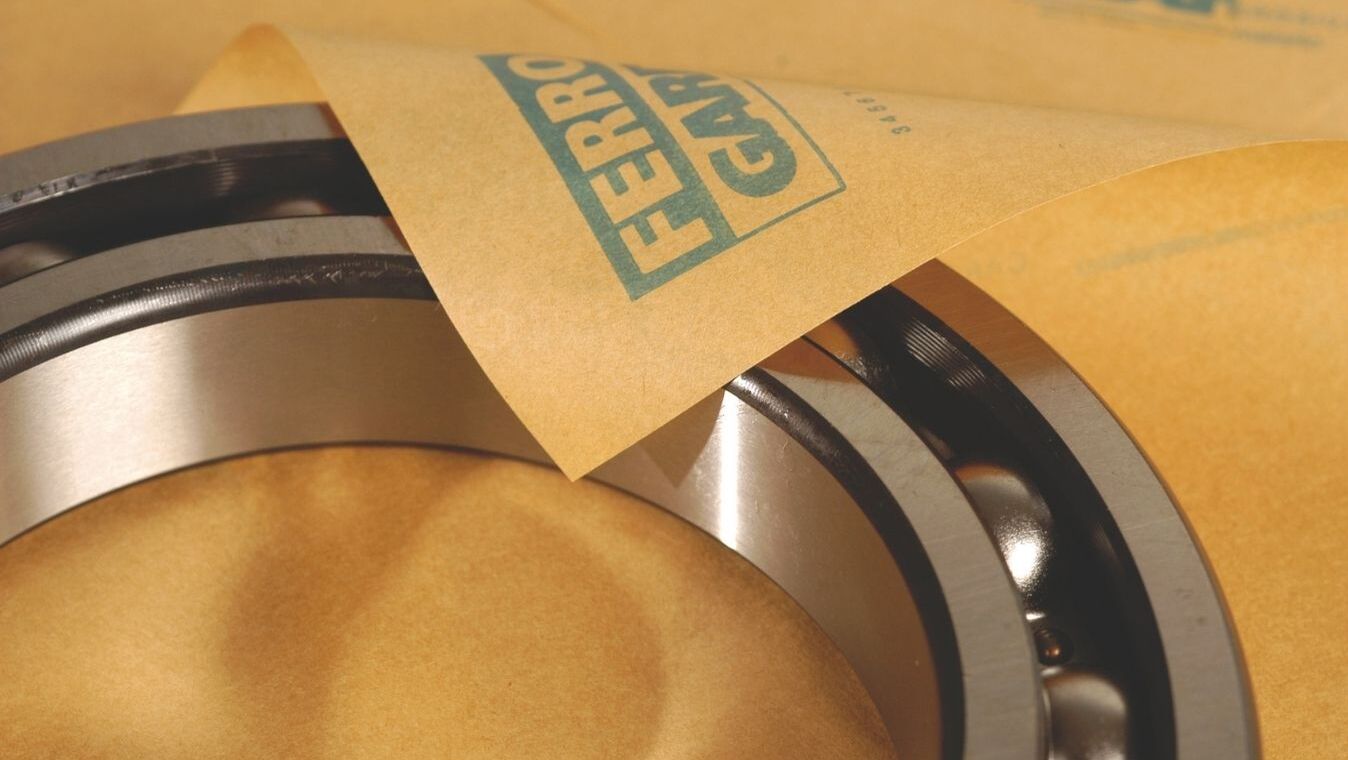
VCI stands for Volatile Corrosion Inhibitor. The term refers to a class of chemical compounds that vaporize into the surrounding atmosphere and protect metal surfaces from corrosive attack.
The development of modern VCI technology began in the mid-20th century, when metal components needed reliable protection against corrosion during extended periods of transportation and storage. Since then, the technology has been continuously refined and has become an integral part of many industrial packaging and logistics processes.
VCI protection should be distinguished from permanent corrosion protection methods such as coatings, paints, or galvanization. VCI is intentionally designed as a temporary solution: it protects metal parts during storage and transport and is intended to allow immediate use or further processing after unpacking without the need for additional cleaning.
The Key Facts About VCI Corrosion Protection at a Glance
- VCI stands for Volatile Corrosion Inhibitor – volatile substances protect metal surfaces without direct contact.
- The gaseous molecules penetrate cavities, threads and bores, protecting hard-to-reach areas.
- VCI protection is designed to be temporary – once the packaging is opened, the substances volatilise, usually without the need for additional cleaning.
- Available as paper, film, bags, corrugated board or depots – for virtually any application and metal type.
How Does VCI Corrosion Protection Work? – The Operating Principle Explained Simply
The basic principle of VCI corrosion protection is as elegant as it is effective: VCI active substances are embedded in a carrier material – such as paper, film or foam. Once the carrier material is placed inside a closed package, the substances are released and pass into the gas phase.
From the Gas Phase to the Protective Layer
The gaseous VCI molecules distribute themselves evenly throughout the packaging atmosphere and reach the metal surfaces inside the package by diffusion. There they are deposited and form an extremely thin protective layer. This acts as a barrier between the metal and corrosive influences such as moisture, oxygen or air pollutants. The electrochemical reactions that lead to rust and corrosion are thereby effectively inhibited or significantly slowed.
Protection Even in Hard-to-Reach Areas
One of the decisive advantages over oils or greases: VCI acts not only where the protective material is in direct contact with the metal, but also at a distance. The gaseous molecules penetrate cavities, internal threads, bores and folds – areas that are difficult to reach with liquid lubricants.
For optimum protection, the VCI source should be positioned as close as possible to the metal surfaces to be protected, so that the protective atmosphere can build up evenly.
Self-Regenerating Protection
If a VCI package is briefly opened in the interim, the protective atmosphere can rebuild itself once the package is resealed – provided sufficient active substance remains in the carrier material. Once the packaging is finally opened, the VCI substances volatilise again, so that the metal parts can generally be further processed or used without additional cleaning.
VCI Products at a Glance: Film, Paper, Bags & More
VCI active substances can be incorporated into a wide variety of carrier materials. Depending on the application, metal type, component geometry and required protection period, different product forms are used.
VCI Paper
VCI corrosion protection paper is one of the most commonly used VCI products. It typically consists of kraft paper that has been impregnated or coated with VCI active substances. Since paper generally releases the active substance faster and in greater quantities than film, it is particularly well suited to short-term applications and irregularly shaped metal parts that are wrapped or used as an interlayer.
BRANOpac offers a graded range with the BRANOrost product lines – from standard papers for straightforward requirements to premium variants with particularly fast protection build-up times for ferrous, steel and non-ferrous metals.
VCI Film
VCI films are manufactured from plastics such as LDPE, into which the VCI active substance is incorporated directly during extrusion. The film releases the inhibitor more slowly and evenly than paper, which – depending on the product, packaging design and storage conditions – can allow protection periods of up to 36 months.
A practical advantage: VCI films are transparent. The goods remain visible and do not need to be opened for visual inspections, such as at customs. The BRANOfol family from BRANOpac covers this spectrum – from simple tubular film for small parts through to multi-layer specialist films with antistatic or enhanced moisture barrier properties for the electronics industry.
VCI Bags and Hoods
VCI bags combine the mechanical protective function of packaging with the chemical corrosion protection of the inhibitor. They are particularly suitable for loose small parts or individual assemblies and are available in various sizes. Hoods are ideal for larger machines or units.
VCI Corrosion Protection Depots and Dispenser Systems
Where metal parts are stored in existing containers or transport crates, VCI dispenser systems offer a flexible solution: chips, foam pads or granules are simply placed in the packaging and continuously release VCI active substances.
With BRANOrost Chips from BRANOpac, for example, one cubic metre of packaging volume can be effectively supplied with a protective atmosphere using just half a square metre of cellulose material.
VCI Corrugated Board and Cartons
For applications where greater mechanical stability is required, VCI corrugated board and VCI cartons offer a practical option. They protect not only against corrosion but also provide impact protection and, as single-material packaging, can be recycled particularly easily.
Which Metals and Industries Is VCI Suitable For?
Suitable Metals
VCI corrosion protection is fundamentally suitable for a wide range of metallic materials, including:
- Steel (unalloyed and alloyed)
- Iron and cast iron
- Copper
- Brass
- Bronze
- Zinc
- Chromium
- Nickel
- Stainless steel
- Cadmium
- Electrolytically galvanised surfaces
- Tinplate
With aluminium, magnesium and silver, compatibility may vary depending on the VCI formulation. A prior test with the respective product is recommended here. BRANOpac provides support for such compatibility checks in its own BRANOscience laboratory.
Typical Industries and Fields of Application
Mechanical and plant engineering: Protection of assemblies, shafts, bearings and precision parts during interim storage or dispatch.
Automotive industry and suppliers: Protection of stamped parts, body components and engine parts – often with OEM-specific test requirements.
Steel industry and metal processing: Long-term protection for coils, sheet metal and semi-finished products.
Electrical engineering and electronics: Delicate copper components benefit from VCI films with tarnish protection.
Export packaging and sea freight: A proven solution for long transport routes, changing climate zones and high humidity – also in combination with specialist export packaging.
Tooling industry: Protection of cutting tools, moulds and fixtures during seasonal storage.

Would you like to know which VCI product is best suited to your metals and requirements? Florian Wirth and the BRANOpac team are happy to advise you – from product selection to tailored packaging solutions.
Get in touch nowApplying VCI Correctly: Tips for Optimum Protection
The effectiveness of VCI corrosion protection depends significantly on how the packaging is prepared and carried out:
- Cleanliness first: Metal parts must be dry and free from dirt as well as oil and grease residues. Wearing gloves prevents perspiration from remaining on the surfaces.
- Allow for temperature equalisation: Metal parts should be cooled to ambient temperature before packaging to avoid condensation inside the package.
- Position the VCI source sensibly: The carrier material should be placed as close as possible to the surfaces to be protected.
- Seal the packaging tightly: The protective effect only develops in a largely closed package. The tighter the enclosure, the more stable the VCI atmosphere.
- Store in a dry, cool place: Dry, cool and light-protected storage additionally supports the protective effect.
- Use combinations: VCI paper and VCI film can be combined without difficulty. For more demanding applications, corrosion protection depots can be added.
VCI Compared: Advantages Over Oil and Other Methods
For a long time, oiling or greasing metal parts was the standard method for temporary corrosion protection. Although this method is effective, it brings certain disadvantages: oil only reaches difficult areas to a limited extent, must often be removed before further processing and causes additional effort through cleaning processes.
VCI corrosion protection avoids many of these drawbacks. The following overview summarises the key differences:
| Criterion | VCI Corrosion Protection | Oil/Grease Preservation |
|---|---|---|
| Cleaning before further processing | Generally not required | Laborious degreasing required |
| Accessibility of difficult areas | Very good, including hard-to-reach areas | Limited |
| Handling | Simple and clean | Messy and labour-intensive |
| Environmental aspects | Less cleaning effort, fewer additional process steps | Cleaning agents and solvents frequently required |
| Protection of concealed areas | Very good | Limited |
As one of the world's leading manufacturers in the field of temporary corrosion protection, BRANOpac develops VCI products for a broad spectrum of industrial requirements – from corrosion protection paper for everyday use through to tailor-made specialist films for the automotive industry or export packaging.
VCI stands for Volatile Corrosion Inhibitor – volatile corrosion inhibitors that protect metal surfaces from rust and corrosion during storage and transport. The active substances are incorporated into carrier materials such as paper, film or bags and pass into the gas phase to build up a protective atmosphere around the metal parts.
VCI is suitable for a wide range of metallic materials, including steel, iron, copper, brass, bronze, zinc, chromium, nickel, stainless steel and galvanised surfaces. Compatibility with aluminium, magnesium and silver may vary depending on the VCI formulation – a prior test is recommended.
As a rule, no. Once the VCI packaging is opened, the active substances volatilise, meaning the metal parts can usually be further processed or used directly without additional cleaning. This is a key advantage over oil or grease preservation, which requires laborious degreasing.
VCI paper releases the active substance faster and in greater quantities, making it particularly suitable for short-term applications and irregularly shaped parts. VCI film made from LDPE releases the inhibitor more slowly and evenly, which – depending on the product and conditions – can allow protection periods of up to 36 months. VCI film is also transparent, so the goods remain visible without opening the packaging.
For optimum protection, metal parts should be dry, clean and free from oil and grease residues. Wearing gloves prevents perspiration marks. Parts should be cooled to ambient temperature before packaging to avoid condensation. A tightly sealed package is also essential so that the VCI protective atmosphere can build up in a stable manner.