![[Translate to English:] Achim Hamann](/fileadmin/_processed_/1/3/csm_achim_hamann_5edf4c4ea1.png "[Translate to English:] Achim Hamann")
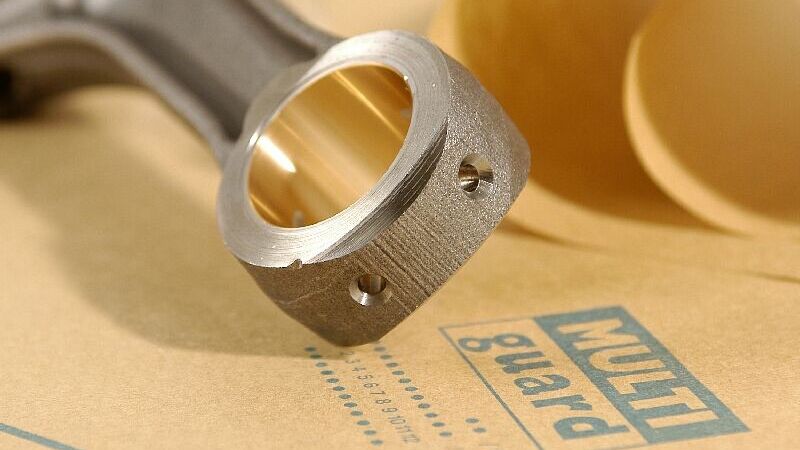
Metal parts rust—often faster than expected. Moisture, oxygen, and temperature fluctuations can affect steel, aluminum, and copper during transport and storage. The result: quality issues, customer complaints, and unnecessary costs. VCI paper offers an elegant solution: it actively protects metal parts against corrosion—without oiling, without residues, and without the need for extensive cleaning before further processing. In this article, you will learn how it works and when VCI paper is the right choice.
The key facts about VCI paper at a glance
- VCI paper actively protects metal parts against corrosion – through volatile corrosion inhibitors that build up a protective atmosphere inside the packaging.
- No oiling required: metal parts are ready for immediate use after storage, as the active substances leave the surface without residue.
- Suitable for a wide range of ferrous and non-ferrous metals, including steel, aluminium, copper, brass and bronze.
- BRANOrost from BRANOpac is a tried-and-tested premium VCI corrosion protection paper – paper-based, recyclable and approved in accordance with TRGS 615.
What is VCI paper? – Principle and definition
VCI stands for Volatile Corrosion Inhibitor. VCI paper is a high-quality kraft paper that has been impregnated with these inhibitors. Inside a sealed package, the active substances continuously release small amounts of corrosion-inhibiting compounds, which disperse through the air and build up a protective atmosphere.
It is worth noting that the term "corrosion protection paper" is often used as a general term. VCI paper, however, is a specific product category with an active mode of action – it does not merely protect through a physical barrier, but through chemically active molecules that directly intervene in the corrosion process.
VCI paper vs. oiling – the clean alternative
Oiling or greasing metal parts prior to storage used to be standard practice. This method has clear drawbacks, however: oil must be fully removed before further processing, hard-to-reach areas are difficult to protect evenly, and the process is time-consuming. VCI paper replaces this step entirely. Metal parts are ready for immediate use after storage – no cleaning required, no residues left behind.
How VCI paper protects metal – the mechanism in detail
The protective action of VCI paper is based on a physicochemical principle: the corrosion inhibitors contained in the paper evaporate slowly and disperse within the packaging. On the metal surface, they deposit as a moisture-repellent protective film. This film prevents moisture and oxygen from reacting with the metal – the primary triggers of corrosion are neutralised at the point of action.
The effective range depends on several factors, including the volume of the packaging, the seal integrity of the outer packaging and the product variant selected. Manufacturers provide product-specific recommendations that should be taken into account when designing the packaging solution.
Once the packaging is opened, the active substances leave the metal surface without residue. The metal parts can then be used directly without any further treatment.
Which metals can be protected with VCI paper?
VCI paper is suitable for a broad range of metallic materials. Depending on the product variant, ferrous metals such as steel and cast iron can be protected, as well as non-ferrous metals including aluminium, copper, brass, bronze and zinc. For applications involving mixed metal combinations – so-called multi-metal situations – specialist variants are available that are tailored to multiple metal types.
Applications: when and for what is VCI paper suitable?
VCI paper is the right choice whenever metal parts need to be stored or transported over an extended period – without oiling and without complex packaging processes. Typical areas of application include mechanical and plant engineering, the automotive industry and the metal processing sector. In the aftermarket segment, where spare parts are held in stock for months or years, VCI paper has also established itself as an effective solution.
Application forms – wrapping, interleaving, container lining
VCI paper can be used in a flexible range of ways. Smaller parts such as precision components, shafts, bearings or milled and turned parts are wrapped directly. For larger assemblies or pallets, sheets are used as interleaving material between the metal parts. For entire containers, crates or transport frames, VCI paper is suitable as a lining material – ensuring that a protective atmosphere is established throughout the interior.
Export packaging and container shipping – special requirements
During international transport, particularly by sea, temperature fluctuations and high humidity inside containers pose a significant corrosion risk. Condensation can form on metal surfaces and promote rust formation. VCI paper can be used here as part of an overall protection concept – combined with moisture-regulating measures such as desiccants. For particularly demanding export packaging requirements, consultation with a specialist in temporary corrosion protection is recommended.

Would you like to protect metal parts reliably against corrosion – without oiling and without time-consuming cleaning? BRANOpac will advise you on selecting the right VCI paper for your application. Get in touch with us today.
Contact us nowVCI paper from BRANOpac: BRANOrost at a glance
BRANOpac develops and manufactures VCI corrosion protection papers under the BRANOrost brand name. These papers are made from high-quality kraft paper and are fully impregnated with VCI active substances. BRANOrost acts on both sides – both in direct contact with the metal and at a distance – making it suitable for all common packaging formats.
The BRANOrost range comprises various performance grades, which differ in terms of protection build-up speed, protection intensity and the appropriate conditions of use. Premium variants establish the protective atmosphere particularly quickly and are suitable even for demanding applications with high moisture exposure. The achievable protection duration depends on climatic conditions, the seal integrity of the packaging and the product variant selected, and can be maintained over an extended period under suitable conditions.
BRANOrost meets the requirements of TRGS 615 and is non-hazardous to health. BRANOpac is certified to ISO 9001 and ISO 14001. As the paper substrate is made from renewable raw materials and is recyclable, VCI paper represents a more environmentally friendly option compared to plastic films.
A detailed overview of the individual BRANOrost variants, available formats and technical specifications can be found in the BRANOpedia article on BRANOrost corrosion protection paper.
VCI paper or VCI film – which is right for your application?
In addition to VCI paper, BRANOpac also offers VCI films. Both product groups use the same operating principle, but differ considerably in their properties and areas of application.
VCI paper releases the active substance more quickly and additionally absorbs moisture from the packaging atmosphere – a clear advantage in humid environments. It is more cost-effective than VCI film, mechanically robust for wrapping, and easier to recycle due to its paper-based composition. Uncoated VCI paper can be disposed of via the paper recycling stream.
VCI film, on the other hand, provides a higher barrier against external moisture and air, and is particularly suitable for parts that need to be heat-sealed in a fully airtight and moisture-proof manner. Film is also the better choice for very smooth or sensitive surfaces where paper could leave mechanical marks.
In summary: VCI paper excels in speed, sustainability and moisture absorption – VCI film in maximum barrier performance. Which solution is best suited to your specific application depends on the metal type, packaging format, transport conditions and required protection duration. BRANOpac will be happy to advise you.
VCI stands for Volatile Corrosion Inhibitor. Paper is particularly well suited as a carrier because it absorbs the active substances evenly and releases them in a controlled manner. Paper also absorbs moisture from the packaging atmosphere, which further reduces the tendency towards corrosion. As a renewable raw material, it is recyclable and therefore a more environmentally friendly alternative to plastic films.
VCI paper is suitable for a broad range of metallic materials, including steel, cast iron, aluminium, copper, brass, bronze and zinc. Specialist multi-metal variants are available for applications involving mixed metal combinations. The most appropriate product variant depends on the metals used – BRANOpac will be happy to advise you.
The protection duration depends on several factors, including the climatic conditions during transport and storage, the seal integrity of the outer packaging and the product variant selected. Under suitable conditions, protection can be maintained over an extended period. Please refer to the relevant technical data sheets for product-specific details, or contact BRANOpac directly.
No. Once the packaging is opened, the VCI active substances leave the metal surface without residue. Parts are ready for immediate use and do not need to be cleaned. This is one of the key advantages of VCI paper over conventional oiling, which always requires time-consuming degreasing prior to further processing.
Conventional paper without VCI active substances offers no active corrosion protection. It cannot retain airborne pollutants or moisture and does not protect metal surfaces from oxidation. VCI paper, by contrast, actively releases corrosion inhibitors that build up a protective atmosphere inside the packaging and protect the metal surface in a targeted manner. Only VCI-impregnated paper is therefore suitable for effective corrosion protection.