![[Translate to English:] Petra Keller](/fileadmin/_processed_/a/1/csm_petra_keller_e44ef7ef02.png "[Translate to English:] Petra Keller")
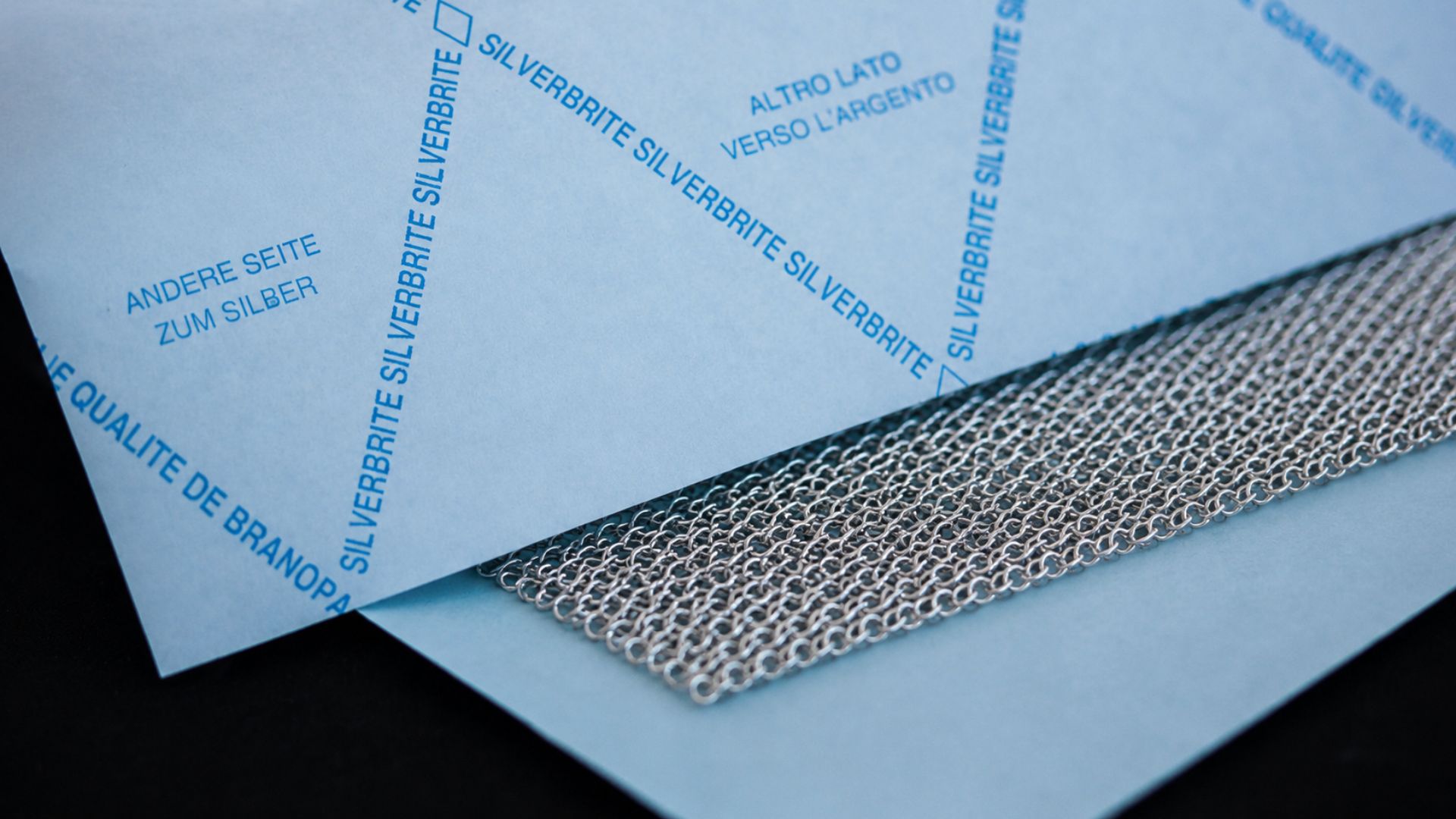
Silver mesh is among the most sensitive components in industrial manufacturing. Even trace amounts of sulfur compounds in the surrounding air are enough to discolour surfaces – with tangible consequences for function and quality. Anyone who stacks, stores or ships silver mesh knows the problem: conventional packaging solutions quickly reach their limits. Silverbrite, the specialised tarnish protection paper from BRANOpac, addresses exactly this challenge – with a protective principle that works reliably without complicating the process.
The Most Important Facts About Silverbrite at a Glance
- Silverbrite actively binds sulphurous airborne compounds and prevents silver surfaces from tarnishing – without requiring airtight sealing.
- The bleached kraft paper is neutral towards silver and does not release any harmful substances itself.
- The protective effect remains active for several months – suitable for both storage and transport.
- Silverbrite is available as rolls, sheets or bags and can be used as an interleaving layer without any process changes.
The Problem: Why Silver Mesh Tarnishes During Stacking and Transport
Why Does Silver Tarnish? Sulphur Compounds as the Main Cause
Silver is particularly sensitive to sulphur-containing compounds in the air – such as hydrogen sulphide (H₂S) and related compounds that are present even in normal ambient air in trace amounts. These trigger a chemical reaction in which silver sulphide forms on the surface. The result is the characteristic discolouration known as tarnishing – ranging from a slight yellow tint to a deep black sulphide layer. Critically, this process occurs even when silver parts are packaged, as long as air exchange with the surroundings is possible.
The Classic Problem with Paper as an Interleaving Material
When stacking silver mesh, conventional paper is often used as an interleaving material – such as tissue paper or uncoated kraft paper. However, these materials offer no active protection against sulphur compounds and cannot retain airborne contaminants. Tarnish marks appear primarily at the contact surfaces between the paper and the silver mesh – a problem that in practice is often only noticed during quality control or at the customer's premises.
Why Aluminium Composite Bags Alone Are Not Enough
Aluminium composite bags are a proven protective packaging for sensitive metal parts. However, their protective effect depends heavily on the seal integrity and handling. During filling, removal or intermediate storage, air can enter the bag – and with it sulphur compounds that can cause stacked silver mesh to tarnish at the contact surfaces. An additional interleaving material with active protective properties can therefore significantly increase the reliability of overall protection.
The Solution: Silverbrite – Tarnish Protection Paper for Industrial Applications
What Is Silverbrite? Properties and Mode of Action
Silverbrite is a specially developed silver protection paper from BRANOpac, specifically designed to protect silver surfaces in industrial applications. The base material is a bleached kraft paper coated with an active agent that binds sulphurous airborne compounds and prevents their reaction with silver – before they can attack the surface. The paper does not work through airtight sealing but through active absorption: air exchange remains possible, while harmful compounds are effectively intercepted.
Bleached Kraft Paper with Active Coating – How It Works
The protective effect of Silverbrite is based on an active coating integrated into the carrier material. The active agents bind sulphurous airborne components and prevent their reaction with the silver surface. The bleached kraft paper itself is neutral towards silver and does not release any harmful substances – an important distinction from conventional paper types that offer no active protection. The active agents are designed to remain effective for several months – ideal for both storage and transport.
Air Exchange Yes – Sulphur Compounds No: The Protection Principle Explained
A key advantage of Silverbrite over purely barrier-based packaging solutions is that the paper remains breathable. No hermetic seal needs to be achieved – the paper acts as an active barrier that "filters" contaminant-laden air without completely preventing natural air exchange. This significantly simplifies the packaging process: Silverbrite can be used as a simple interleaving layer between stacked components, without the need for vacuuming or special equipment.
Application Example: Silver Mesh (200×200 mm) – From Problem to Series Production
Initial Situation: 5 Stacked Silver Mesh Pieces in an Aluminium Composite Bag
A manufacturer of precision components produced silver mesh measuring 200×200 mm, which were stacked in batches of five and packaged in aluminium composite bags. The surface quality requirements were high: tarnishing or discolouration led to complaints from customers and, in individual cases, to functional impairments of the components. Despite the protective packaging, tarnish marks continued to appear – a problem that urgently needed to be resolved.
The Challenge with Conventional Paper as an Interleaving Material
Conventional paper was initially used as an interleaving layer between the individual silver mesh pieces to prevent scratches and direct metal contact. However, this paper offered no protection against sulphur compounds and was unable to retain airborne contaminants. The tarnish marks appeared primarily at the contact surfaces between the paper and the silver mesh, clearly indicating the inadequacy of the interleaving material.
Implementation with Silverbrite: How Tarnish Protection Was Achieved
The solution was to replace the conventional interleaving layer with Silverbrite protection paper cut to the appropriate size. The paper was placed as an interleaving layer between each of the five silver mesh pieces – without any further changes to the existing packaging process or the bag packaging. The straightforward integration was a key advantage: no retooling, no new machinery, no additional process step. Silverbrite was seamlessly incorporated into the existing workflow.
Result: Tarnish Problems Significantly Reduced – Noticeable Quality Improvement
After switching to Silverbrite as the interleaving layer, tarnish problems in this typical application case were significantly reduced. The silver mesh reached the customer in perfect condition – without visible discolouration. The protective effect can last throughout the entire storage and transport period, which may span several months. The example demonstrates how a targeted material change in the interleaving layer can deliver a noticeable quality improvement – with minimal effort and no changes to existing processes.

Would you like to reliably protect silver mesh or other silver components from tarnishing? Get in touch with us – we will help you find the right Silverbrite solution for your specific application.
Contact us nowAreas of Application for Silverbrite at a Glance
Industry: Protection of Silver-Plated Contacts and Technical Components
In the electronics industry and connector technology, silver-plated contacts and precision components are particularly susceptible to tarnishing. Even minimal sulphide layers can impair electrical conductivity and lead to malfunctions. Silverbrite is suitable as an interleaving and wrapping material for silver-plated connectors, contact elements and technical silver components – wherever surface quality and functional reliability are directly linked.
Storage and Transport of Silver Parts
Whether in the warehouse, in transit or at the customer's site: Silverbrite can effectively protect silver parts throughout the entire delivery process. The paper is available in rolls, sheets and bags, and can be flexibly cut to individual formats and process requirements. Customer-specific variants are also available for specific requirements. This allows Silverbrite to be integrated precisely into a wide range of packaging and logistics processes.
Supplementary Use in the Consumer Sector
In addition to industrial applications, Silverbrite is also suitable for protecting silver jewellery, cutlery and other silver objects in the private sector. Anyone wishing to store high-quality silver objects for a longer period will benefit from the easy handling and effective protection – without specialist knowledge or complex packaging technology.
Silverbrite Compared: Why Conventional Solutions Often Fall Short
Conventional Paper / Tissue Paper
Tissue paper and uncoated kraft paper are inexpensive and widely used – but offer no active protection against sulphur compounds. While they prevent mechanical damage, they cannot retain airborne contaminants or halt the chemical tarnishing process.
Airtight Bags (PE, Aluminium)
Airtight bags made of PE or aluminium composite film can effectively protect silver parts – however, their protective effect depends heavily on seal integrity and handling. In combination with Silverbrite as an interleaving layer, the overall protective performance of the bag packaging can be significantly improved and made more reliable. For more on temporary corrosion protection in general, see our BRANOpedia article.
Anti-Tarnish Strips
Anti-tarnish strips are small insert strips with a similar mode of action to Silverbrite – they chemically bind sulphurous airborne components. They are practical for individual pieces of jewellery or small containers, but impractical for industrial series production with larger components and defined interleaving formats. Silverbrite combines active protection with the flexibility of a sheet material that can be cut to size – making it far better suited for industrial processes. An overview of further corrosion protection papers is also available in BRANOpedia.
The active agents in Silverbrite are designed to remain effective for several months – both during storage and transport.
Yes, Silverbrite is generally suitable for protecting silver-plated surfaces on technical components such as contact elements or connectors. For specific requirements, we recommend consulting with BRANOpac.
Silverbrite is available in rolls, sheets and bags. Customer-specific variants and cut-to-size formats are also available on request.
Silverbrite is simply placed between the silver parts to be protected – one sheet per contact surface. No additional tools, vacuuming or process changes are required.
Silverbrite is primarily designed as a supplementary interleaving layer, not as a complete replacement for bag packaging. However, in combination with an aluminium composite bag, the overall protective performance can be significantly improved.